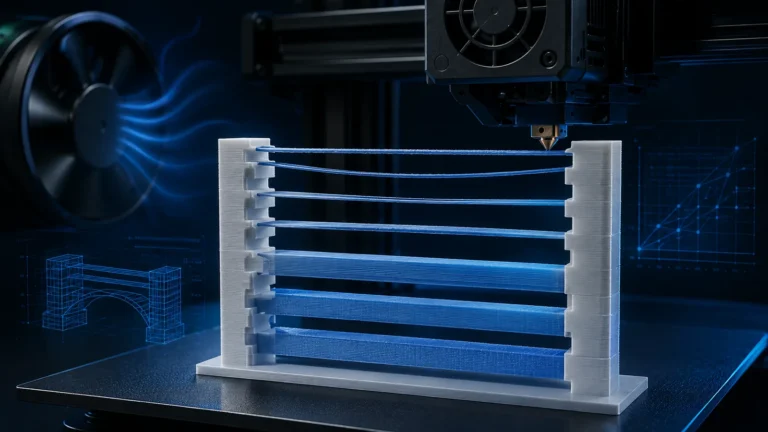
PLA and PETG can use deliberately weak inter-material adhesion as a support interface. With ABS, ASA, PC and Nylon/PA, the problem becomes much more demanding: these materials run hotter, often need an enclosure, and are more sensitive to temperature transitions, moisture and contamination inside a shared hotend.
The key question is therefore not simply “which filament does not stick to which?” A useful interface must combine compatible nozzle/chamber temperatures, enough adhesion during printing, reliable separation afterward and stable material feeding. A chemically attractive pairing is useless if the interface filament softens at 280 °C or clogs during every material swap.
Why engineering materials are harder than PLA/PETG
A support interface has to achieve two conflicting goals:
- It must bond well enough during printing to support the overhang.
- It must separate predictably afterward without damaging the part.
ABS, ASA, PC and PA add thermal constraints. OrcaSlicer lists typical nozzle ranges around 230–260 °C for ABS/ASA, roughly 225–260 °C for common nylons, and up to about 270–310 °C for PC. Several of these materials also benefit from a heated chamber. The interface filament has to survive that environment.
Use the special material for the interface, not the whole support
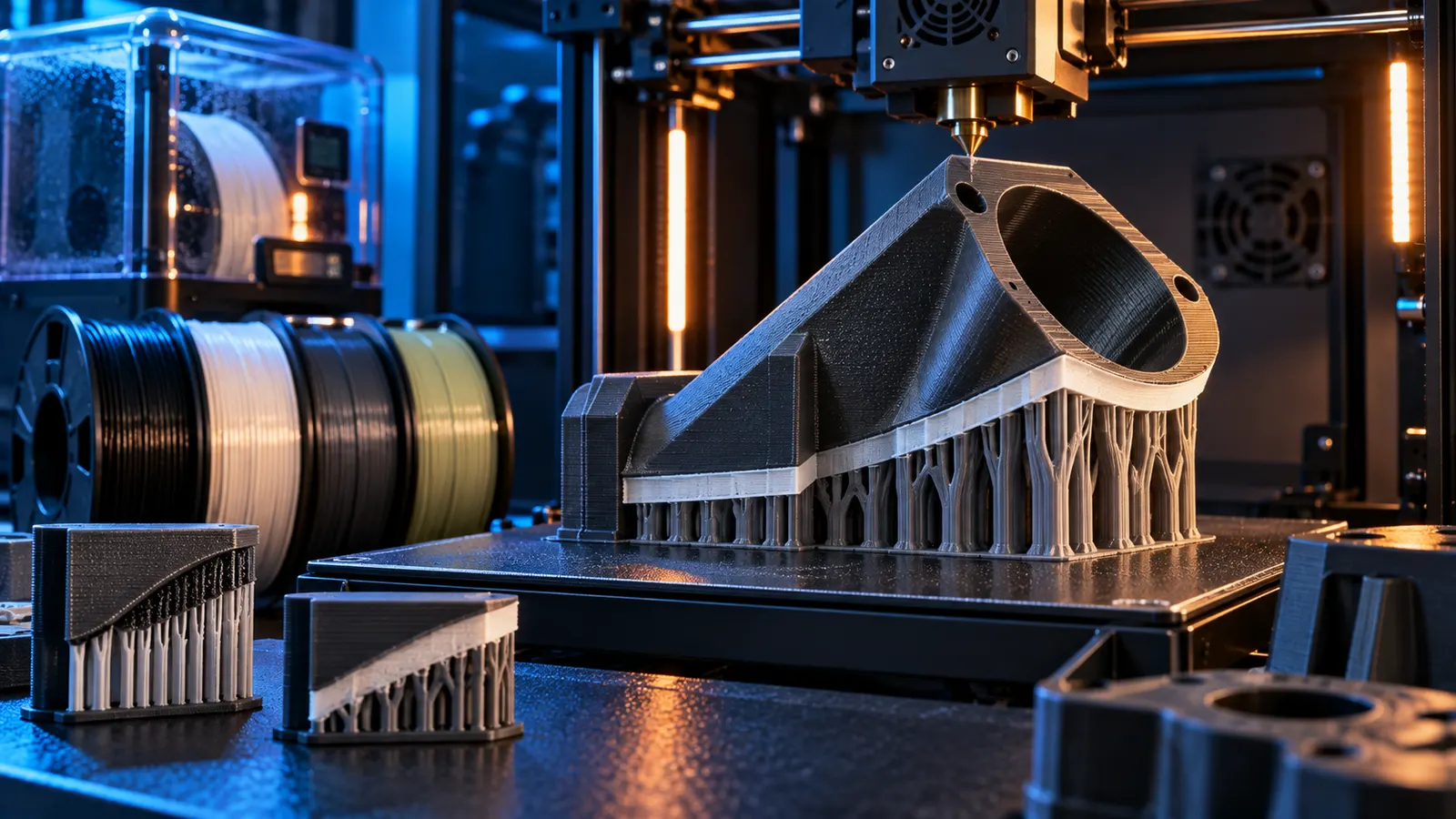
In most engineering workflows, the second material should print only the dense contact layers. Keep the support body in the model material. This reduces expensive interface material, limits tool changes and avoids building a large support structure from a deliberately weak material pairing.
OrcaSlicer separates Support Base and Support Interface Filament. When multiple interface layers are used, Orca also inserts a base-material bonding layer behind the interface so the transition to the support body remains mechanically stable.
For the simpler low-temperature case, see our PLA/PETG support-interface guide.
Which pairings are realistic?
| Model material | Possible interface strategy | Practical view |
|---|---|---|
| ABS | HIPS or dedicated ABS support material | well documented; HIPS can be dissolved in limonene |
| ASA | same-material support or tested high-temp breakaway | do not automatically copy every ABS pairing; formulations differ |
| PC | same-material support or vendor-qualified high-temp support | very high thermal window; avoid casual low-temp pairings |
| PA12 / long-chain Nylon | dedicated PA12 breakaway support | excellent option when the exact polymer family is supported |
| PA6 / CoPA / PA-CF/GF | product-specific PA support | check exact compatibility; PA12 support is not automatically suitable for PA6/CoPA |
This table is deliberately conservative. “Nylon” is not one material. An interface that separates beautifully from PA12 may behave very differently with PA6 or CoPA.
ABS: HIPS is the classic soluble route
Prusa documents HIPS as a practical soluble-support alternative for ABS. HIPS can be dissolved with limonene and operates much closer to the ABS temperature range than traditional PVA/BVOH supports.
This is useful for internal geometry that cannot be reached mechanically. The trade-off is post-processing: solvents require appropriate handling, disposal and additional time.
Bambu also lists a dedicated Support for ABS with a typical 240–270 °C nozzle range. It is a good example of why a purpose-built engineering support can be more reliable than choosing an arbitrary filament merely because adhesion is weak.
ASA: similar to ABS does not mean identical
ASA and ABS are often grouped together because their nozzle and chamber requirements overlap. That does not guarantee identical interface adhesion.
For ASA, a sensible order is:
- Start with tuned same-material support.
- If the underside is not good enough, check vendor-qualified high-temperature breakaway materials.
- Only test ABS/HIPS-like pairings on a small coupon before committing to a long print.
Large ASA parts are also sensitive to differential shrinkage. An interface material with very different cooling behavior can introduce its own distortion around a wide contact surface.
PC: temperature is the main barrier
Polycarbonate frequently prints at substantially higher nozzle and chamber temperatures than PLA, PETG or ABS. An interface material that works at lower temperature may soften, degrade or feed poorly in a PC process.
For PC, prioritize vendor-qualified high-temperature compatibility. If there is no verified separation material for the exact PC formulation, good same-material supports are usually better than a theoretically low-adhesion pairing that cannot survive the process window.
Nylon/PA: identify the exact polymer family
Nylon support workflows become unreliable when every PA filament is treated as the same polymer. PA6, PA12, CoPA and fiber-filled variants differ in moisture behavior, temperature, shrinkage and interface adhesion.
Polymaker’s PolySupport for PA12, for example, is explicitly designed for PA12 and long-chain nylons and specifically warns against using it with CoPA. That is a useful reminder of how targeted engineering-support chemistry can be.
Bambu lists Support for PA/PET for materials including PAHT-CF, PA6-CF, PA6-GF and PET-CF. It uses a high processing temperature and requires dry handling. “Support for nylon” is therefore far too broad a description — the exact approved material family matters.
Moisture can ruin the interface test
Many polyamides and engineering support materials are highly hygroscopic. Wet filament can cause bubbling, stringing, unstable flow and inconsistent interface roads. At that point it becomes difficult to tell whether the pairing itself is wrong or extrusion is simply unstable.
Polymaker explicitly requires dry conditions for its PA12 support material, while Bambu marks its PA/PET support as requiring drying and dry protection during use. Drying belongs before the compatibility test, not after the first failed long print.
Single nozzle vs toolchanger / IDEX
Engineering support interfaces benefit strongly from separate hotends. A toolchanger or IDEX can keep each material at its own temperature. A shared nozzle has to handle large temperature transitions and aggressive purging.
This is more than a time and waste issue. Residual model material inside the support material — or vice versa — changes interface adhesion. A pairing designed to release cleanly may locally weld because the transition was not purged far enough.
Polymaker explicitly recommends a dual-nozzle printer for PolySupport PA12 because single-nozzle material switching increases clogging risk.
Z gap: 0 mm is not automatically correct
Dedicated interface materials are often used with a very small or zero Z gap. That can produce excellent undersides, but high-temperature interface behavior still depends on formulation, moisture and contact area.
Use zero gap as a starting point only when the vendor profile or support product expects it. If a broad interface requires excessive force to remove, a small positive gap can be more useful than simply applying more mechanical force.
Interface density, pattern and cooling
OrcaSlicer provides separate settings for interface layers, spacing, pattern, speed and even support-interface fan speed. Engineering materials require restraint here: extra fan can weaken the interface and improve removal, but excessive cooling on ABS/ASA/PC can also increase warping and layer problems.
A practical starting strategy is:
- a small number of dense interface layers,
- moderate interface speed,
- do not copy PLA cooling values blindly,
- use a small flat-overhang test coupon.
Soluble or breakaway?
| Type | Advantage | Trade-off |
|---|---|---|
| Breakaway | fast, no solvent, often good surface quality | must remain accessible; wrong pairing can bond too strongly |
| Water-soluble | excellent for internal cavities and complex geometry | moisture sensitivity, storage, dissolving time and temperature compatibility |
| Solvent-based | HIPS/ABS can solve inaccessible support geometry | chemical handling and disposal required |
Practical workflow for a new pairing
- Check manufacturer data: model and interface materials must share a workable thermal window.
- Dry both filaments, especially nylon and PA/PET support.
- Assign the second material to the interface only, not the whole support body.
- Print a coupon: a 20–40 mm flat supported area is enough.
- Use zero gap only when appropriate; test a small positive gap as well.
- Judge separation after full cooling.
- Inspect residue and underside quality.
- Only then commit to the long engineering print.
Common problems
| Problem | Likely cause | Check |
|---|---|---|
| Interface welds to part | pairing too compatible, too hot, contamination | Z gap, purge, temperature, vendor compatibility |
| Interface detaches during printing | too little interface adhesion / weak bonding layer | interface layers, pattern, base-material bonding layer |
| PA support pops or strings | moisture | dry and feed from a dry environment |
| shared nozzle clogs after swaps | large temperature delta / residual material | purge, change temperature, separate hotends |
| large ASA/PC underside warps | cooling / chamber gradient / different shrinkage | chamber, fan, smaller interface area |
Conclusion
With ABS, ASA, PC and Nylon, a support interface is not a simple filament trick. The useful pairing is the one where thermal window, moisture control, interface adhesion and printer architecture all work together.
ABS has the established HIPS route and dedicated breakaway products. PA has excellent specialized options, but often only for specific nylon families. For PC and many ASA/PA6/CoPA setups, tuned same-material support or an explicitly qualified high-temperature support remains the more robust choice.
On a shared nozzle, purge and temperature transitions matter just as much as material chemistry. Toolchangers and IDEX systems make this workflow substantially easier to control.
Sources & current status
- OrcaSlicer Wiki – Support Filament
- OrcaSlicer Wiki – Support Interface Layers, Pattern & Spacing
- OrcaSlicer Wiki – Material Temperatures
- Prusa Knowledge Base – soluble support materials / HIPS for ABS
- Bambu Lab – Support Material Comparison incl. ABS and PA/PET
- Polymaker – PolySupport for PA12
Research status: September 22, 2026. Support compatibility depends on vendor, polymer family and formulation. Always validate a new engineering-material pairing with a small interface coupon before a long print.
Frequently asked questions
What support interface material works with ABS?
HIPS is an established soluble option for ABS and can be removed with limonene. Dedicated breakaway ABS support materials also exist.
Can I use HIPS as a support interface for ASA?
Do not assume it universally. ASA and ABS have similar process windows, but formulations and interface adhesion differ. Validate ASA/HIPS on a small coupon first.
What support material should I use with Nylon?
It depends on the PA family. PA12 support is not automatically compatible with PA6 or CoPA. Vendor-qualified compatibility matters.
Can PLA or PETG be used as an interface for PC?
They are usually not a robust default because PC often requires a much higher thermal window. Same-material supports or high-temperature qualified support products are safer.
Why is a toolchanger better for engineering support interfaces?
Separate hotends keep materials at their own temperatures and reduce contamination inside a shared melt path, making interface behavior more repeatable.