
What does IDEX mean?
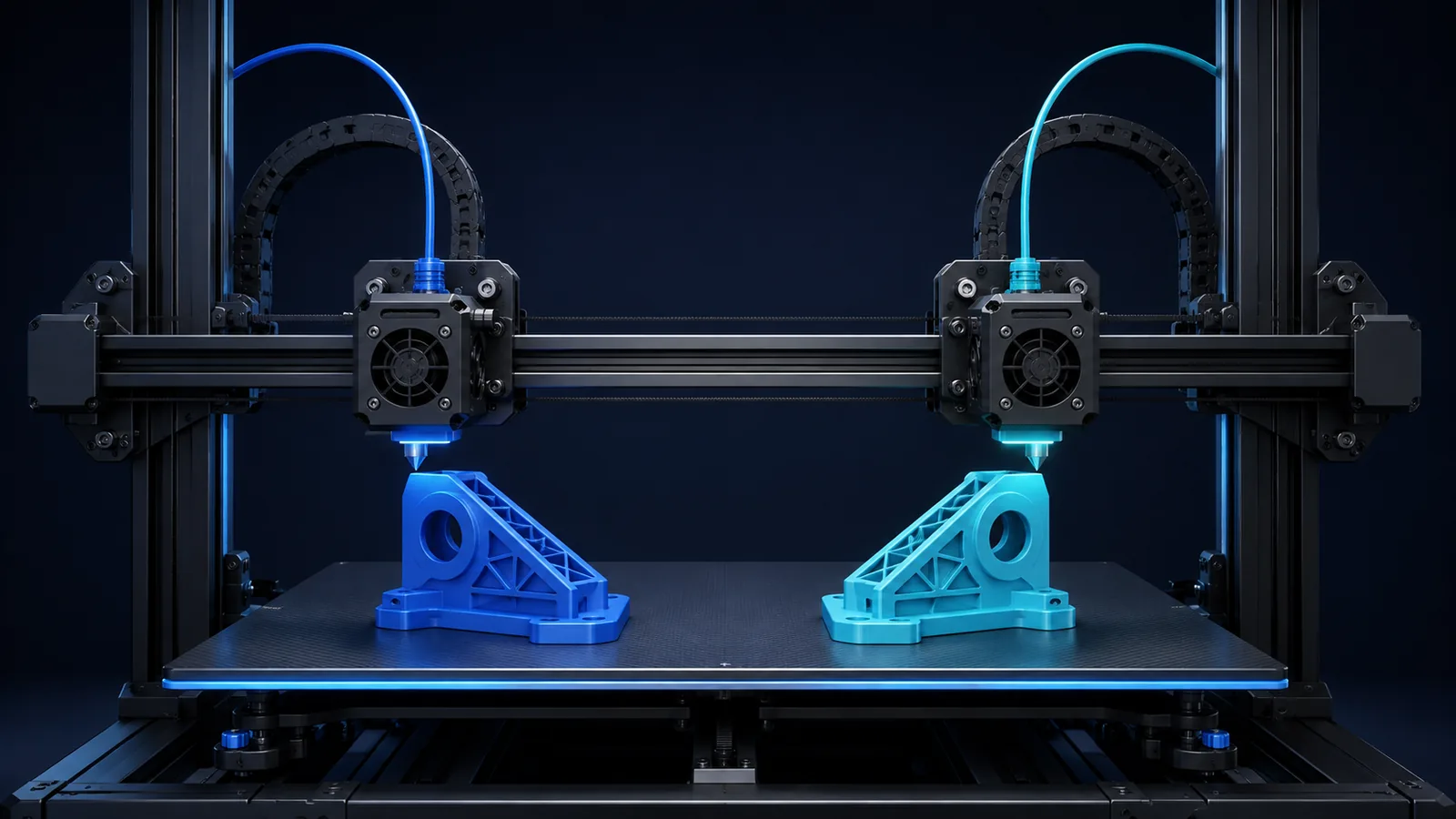
IDEX stands for Independent Dual Extruder. Unlike a conventional dual-extruder carriage, two printheads can move independently along the same X axis. This enables additional operating modes and keeps an inactive nozzle further away from the active print area.
Typical operating modes
- Normal / Dual Material: both heads print different regions, colors or materials.
- Copy / Duplication: both heads print the same part simultaneously.
- Mirror: one head prints the model while the other prints a mirrored version.
- Backup: some systems can switch to the second head if filament runs out or a defined fault occurs.
Snapmaker documents all four modes for the J1/J1s. Copy and Mirror reduce usable width per part because both carriages need collision-safe travel space.
Why IDEX is useful for multi-material
Each head has its own nozzle and can run its own temperature. Materials do not need to be fully flushed through the same melt path at each switch. That can be especially useful for PLA/PETG support interfaces or two materials with very different processing temperatures.
Calibration matters
XY and especially Z offsets must be accurate. A low inactive nozzle can scrape the print, while a wrong XY offset creates visible mismatch at material boundaries.
Ooze and parking still matter
Separate hotends do not eliminate all change-related issues. A parked hot nozzle can ooze. Wipers, standby temperatures and restart priming may still be required.
IDEX is not automatically twice as fast
Copy mode can produce two identical parts in parallel, but not every job benefits equally. Reduced build width, heating, layer time and process constraints still apply. Productivity depends on geometry and workflow.
IDEX vs. Toolchanger
IDEX normally has two permanently mounted heads. A toolchanger can park and pick up several complete tools. Toolchangers scale more naturally beyond two materials/nozzles, while IDEX is particularly strong for Copy/Mirror and two-material workflows.