Bondtech INDX belongs to a new class of multi-material systems. Instead of repeatedly pushing different filaments through the same nozzle, several complete tools stay ready. That changes the workflow fundamentally: colors, different materials and even different nozzle diameters can be used within one print without performing a full filament swap through a single hotend every time.
INDX became especially visible in 2026 through the Prusa collaboration. Conversion kits for CORE One / CORE One+ are available with four or eight tools, and Prusa now also sells complete CORE One+ (Gen 2) INDX printers. One marketing phrase needs careful interpretation, though: a toolchanger does not automatically mean that no priming is ever required. INDX solves this by fully priming the next tool outside the print area, which allows the classic prime/waste tower to be removed.

What is Bondtech INDX?
INDX is a modular toolchanger system from Bondtech. A moving Smart Toolhead picks up the required tool while the other tools remain parked. Each tool can already be loaded with its own filament and nozzle.
This lets common multi-material tasks be handled differently from AMS-, MMU- or similar single-nozzle systems:
- multiple colors without flushing every color through one melt zone,
- rigid and flexible materials in one job,
- soluble or easy-release support interfaces,
- different nozzle diameters in one model,
- much less purge because the previous color does not need to be displaced from the same hotend.
The architecture also differs from IDEX. IDEX normally uses two independently moving extruders on the same axis; INDX manages multiple parked tools and picks up one at a time.
How does the toolchange work?
During a change, the printhead moves to the tool station, drops the active tool and picks up the next one. The incoming tool then has to return to a repeatable position, be thermally ready and resume with stable extrusion immediately.
For the current CORE One+ integration, Prusa states a real material-to-material toolchange of about 12 seconds, measured from the last extrusion of one material to the first extrusion of the next material directly on the model. Fast induction heating and a low-mass nozzle are central to this workflow.
Why INDX needs so little purge
In a classic single-nozzle multicolor system, material A remains inside the melt zone. Material B has to flush that zone before the new color is clean. Large color, material or temperature differences can therefore require substantial purge volume.
With a toolchanger, material A stays inside its own tool while material B is already loaded in another tool. That is why the system does not need to push long lengths of filament through one shared nozzle just to clear the old material.
Other toolchanger systems may still benefit from a small prime or wipe structure depending on material, slicer and implementation. The main advantage is that the large color flush of a shared melt zone disappears.
Four or eight tools: what does that enable?
| Use case | Why multiple tools help |
|---|---|
| Multicolor printing | Each color remains loaded in its own tool. |
| PLA + PETG support interface | Support material does not have to be exchanged through the same hotend. |
| PLA + TPU | A flexible filament can stay in a tool prepared specifically for it. |
| 0.4 + 0.8 mm nozzles | Visible surfaces can stay fine while infill or internal regions use a larger nozzle. |
| Soluble supports | PVA/BVOH can remain isolated instead of repeatedly travelling through a shared melt zone. |
Different nozzle sizes in one print
One of the most interesting capabilities is switching between different nozzle diameters. A smaller nozzle can handle visible contours or fine details while a larger nozzle prints thick internal walls or infill faster. That is more than a color feature: it lets quality and speed be prioritized differently inside the same part.
The slicer still has to manage each tool correctly. Line width, layer height, flow, temperature and MVS remain tool-specific. Different nozzles are not a free speed boost; they require matching profiles and a reliable toolchange workflow.
For general sizing and flow limits, see our Nozzle, Layer & Speed Planner and Max Volumetric Speed guide.
Tool offsets and calibration
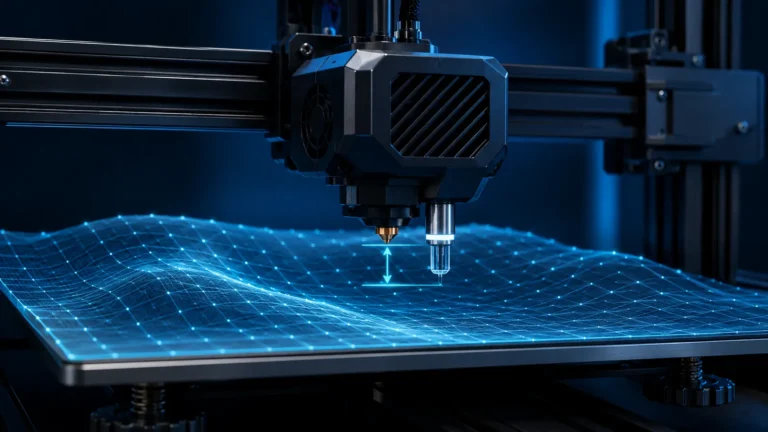
Multiple tools must be aligned very accurately. Even small X/Y/Z offsets become visible at color boundaries and material transitions. The Prusa INDX implementation uses load-cell measurement and automatic eddy-current toolhead offset calibration.
This is a core challenge with every toolchanger: docking must be reliable, but so must repeatability after hundreds of changes. Typical problems include:
- visible offset between colors,
- different effective layer heights between tools,
- poor support-interface transitions,
- collision risk if one nozzle sits lower than the others.
INDX vs. AMS/MMU vs. IDEX
| System | Strength | Typical drawback |
|---|---|---|
| Single-nozzle AMS/MMU | compact, one hotend, many colors | filament-swap time and purge volume |
| INDX / toolchanger | separate tools, materials and nozzle sizes | more mechanical and calibration complexity |
| IDEX | two independent extruders, copy/mirror modes | usually limited to two tools, larger moving assembly |
Our IDEX guide explains the second architecture in more detail. The Toolchanger glossary entry covers the term itself.
Support interfaces: one of the strongest functional use cases
For functional prints, multi-material is not just about color. A second material can be used specifically as a support interface. PLA and PETG, for example, adhere relatively poorly to each other and can create clean separation layers when tuned correctly.
With a shared nozzle, every material swap costs time and purge material. A toolchanger keeps both materials separate and reduces exactly that penalty. See our PLA/PETG support-interface guide for the slicer side of the workflow.
The nozzle issue: “hardened” was not actually fully hardened
An important transparency issue concerns the nozzles shipped with early INDX systems. Bondtech had described the Founders Edition and early CORE One+ conversion-kit nozzles as hardened and suitable for abrasive materials. In late July 2026, Bondtech publicly clarified that this description was not accurate.
The shipped nozzles are nitrocarburized steel and were measured by Bondtech at roughly 30–32 HRC. Bondtech gives roughly 55–60 HRC as context for truly hardened nozzles. Regular PLA, PETG, ABS, ASA, TPU and many other non-abrasive filaments are not the issue; carbon-fiber, glass-fiber, glow-in-the-dark and metal-filled materials can wear the current nozzles much faster.
Current status in September 2026
The Founders Edition is already in customer hands. Since August 2026, the first regular conversion kits for CORE One / CORE One+ have started shipping. Prusa offers the CORE One+ (Gen 2) with four or eight INDX tools as both a kit and an assembled printer. Order options for CORE One L+ INDX were also opened in late August.
Bondtech additionally offers a development-kit path for open/custom platforms and lists Klipper, Kalico and RepRapFirmware among the supported environments. For custom printers, however, this is far more of an engineering project than the integrated Prusa package.
Where are the limits?
- More mechanics: docks, tools, sensors and calibration add more possible failure points.
- More profiles: each material/nozzle combination still needs good settings.
- Toolchanges still cost time: 12 seconds is fast, but thousands of changes still add up.
- Priming has not disappeared: INDX moves it from a conventional tower into a more efficient off-bed process.
- Abrasive materials: current shipped nozzles are not equivalent to fully hardened nozzles.
- Cost: multiple complete tools are mechanically more expensive than a single hotend plus filament changer.
Who benefits most from INDX?
INDX makes the most sense when multi-material is a regular part of the workflow rather than an occasional color effect:
- frequent multicolor prints with many changes,
- functional parts with dedicated support interfaces,
- flexible and rigid materials in the same model,
- different nozzle sizes inside one print,
- users who want to reduce purge waste and long filament swaps.
If you only print two colors occasionally, a conventional filament changer may still be the simpler and cheaper solution.
Conclusion
Bondtech INDX is less a “better AMS” than a different architecture. Complete tools are prepared and exchanged instead of repeatedly swapping materials through one hotend. That is what creates the advantages for multi-material, support interfaces and different nozzle sizes.
The most interesting technical achievement is not simply the phrase “no purge tower,” but the combination of repeatable tool pickup, fast thermal response, automatic offset calibration and very small off-bed priming. At the same time, the system remains more complex than a single-nozzle setup, and the current nozzle situation for abrasive filaments needs to be treated transparently.
Sources & current status
- Bondtech – INDX product and technology overview
- Prusa – CORE One+ Gen 2 INDX shipping and current feature set
- Prusa – State of INDX, July 2026
- Bondtech – INDX Hardened Nozzles Update, July 29, 2026
Research status: September 7, 2026. Availability, firmware, profiles, nozzle options and technical details may still change as this is a young platform.
Frequently asked questions
Does Bondtech INDX need a purge tower?
In the current Prusa integration the incoming tool is fully pre-primed outside the print area, so a conventional waste/prime tower is not required. That is specific to this implementation and not a universal rule for every toolchanger.
How fast is an INDX toolchange?
Prusa states roughly 12 seconds for the current CORE One+ integration, measured from the last extrusion of one material to the first extrusion of the next material on the model.
Can INDX use different nozzle sizes in one print?
Yes. Multiple tools can be prepared with different nozzle diameters, allowing fine visible regions and faster coarse internal regions to use different nozzles.
Are current INDX nozzles suitable for carbon- or glass-fiber filament?
The first shipped nozzles are nitrocarburized steel but are not fully hardened in the conventional sense. Bondtech warns that abrasive CF/GF, glow and metal-filled materials can accelerate wear.
What is the difference between INDX and IDEX?
IDEX typically uses two independently moving extruders. INDX is a toolchanger with multiple parked tools that are picked up by one Smart Toolhead.