A print profile can be reliable for months and suddenly develop under-extrusion, warping or rough surfaces during a heat wave. That is not mysterious: a printer does not operate in a laboratory. Room temperature, enclosure temperature, airflow and humidity all change the thermal conditions around the machine.
Two problems are especially easy to confuse. Heat creep becomes more likely when the cold side of the hotend cannot stay cold enough. Warping is often promoted by cooling that is too fast or too uneven. The enclosure that helps ASA can therefore hurt PLA.
Why ambient temperature matters
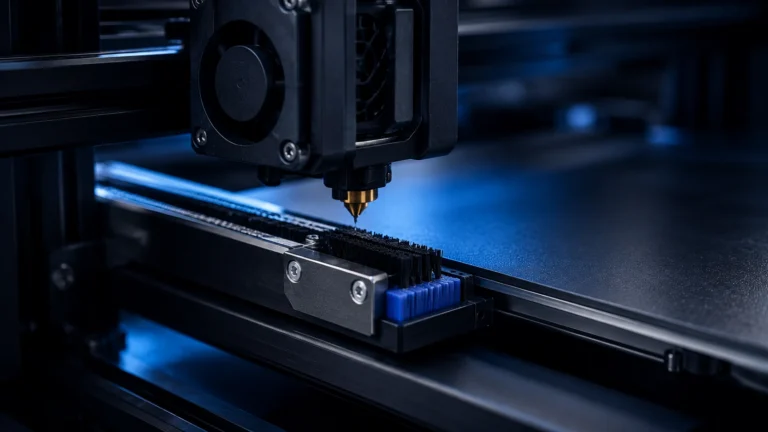
FDM printing depends on several temperature zones at the same time: the heater block melts plastic, the heatbreak should maintain a sharp transition, the heatsink must reject heat, the bed keeps the first layer warm, and part cooling freezes fresh extrusion. Change the room temperature and every one of those heat flows shifts.
Summer problem: heat creep with PLA
Heat creep occurs when heat travels farther up the hotend than intended. Filament softens too early, expands or buckles in the transition zone and becomes difficult to feed. Typical symptoms include extruder clicking, chewed filament, intermittent under-extrusion or a print that starts perfectly and fails later.
A closed printer can make the problem worse with PLA because the chamber warms while the hotend heatsink has less temperature difference available for cooling.
How heat creep differs from a normal clog
- The print often starts cleanly and degrades after time.
- The problem is worse on hot days or with the enclosure closed.
- PLA is often affected more than higher-temperature materials.
- After cooling down, filament may feed normally again.
- A dirty or weak hotend fan can make the same conditions much worse.
If extrusion is poor immediately after heating, inspect the nozzle, filament path and partial clog possibilities as well.
What to do when PLA struggles in a hot room
- Open the door or top of an enclosure when the printer maker recommends this for PLA.
- Check the hotend fan and heatsink for dust and restricted airflow.
- Avoid placing the printer in a closed cabinet or direct sun.
- Do not automatically lower nozzle temperature so far that high-flow sections become under-extruded.
- Watch long, slow prints where little cool filament passes through the hotend.
Cold-room problem: warping and temperature gradients
Thermoplastics shrink as they cool. If one region of a part cools much faster than another, internal stress rises. Once that stress exceeds bed adhesion or inter-layer bonding, corners lift or layers can separate. ABS, ASA, PC and many nylon formulations are much more sensitive to this than PLA.
Drafts can matter more than the room average
A stable 18 °C room can be easier on a technical material than a 22 °C room with an open window blowing directly across the printer. Local airflow creates an asymmetric temperature gradient. Common sources include windows, air conditioning, fans, ventilation ducts and frequently opened exterior doors.
Enclosures are material-dependent
| Material | Warm enclosure | Main risk if too warm |
|---|---|---|
| PLA | Usually unnecessary | Heat creep and softened filament path |
| PETG | Often optional | Excessive softness/ooze depending on setup |
| ABS / ASA | Usually very helpful | Far less problematic than cold drafts |
| PC / PA | Often important | Printer and material limits still matter |
| TPU | Often unnecessary | Feeding behavior can become more sensitive |
Humidity is a separate weather effect
Humid summer air also affects the filament itself. Nylon, TPU and many engineering blends absorb moisture quickly; PETG can also show more stringing and roughness after long exposure. Moisture and heat creep can happen at the same time, but they are different faults and need different fixes.
Why seasonal changes look like “random slicer problems”
If a profile has not changed but the room is suddenly 10 °C warmer, changing five slicer settings at once is a poor diagnostic strategy. Check environment, enclosure, filament condition and hotend cooling first. Use the Troubleshooter to separate heat creep, warping and moisture-related symptoms.
The build plate reacts to the environment too
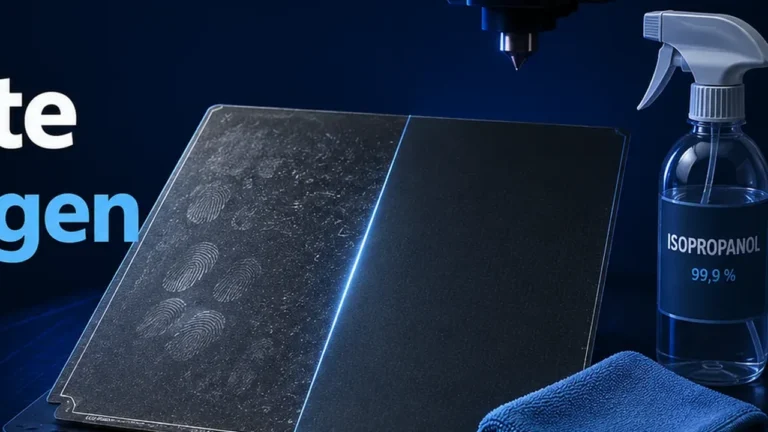
Large beds need time to become thermally stable. Cold airflow can create local surface-temperature differences, while fingerprints can create local adhesion differences that look like a climate problem. If only touched areas lift, clean the plate before blaming the room.