A build plate can look perfectly clean and still fail. The main enemy is often not visible dust but a very thin layer of skin oil, adhesive residue or cleaner residue. Before changing Z offset, bed temperature or first-layer flow, make sure the surface itself is actually clean.
Why fingerprints cause so many adhesion problems
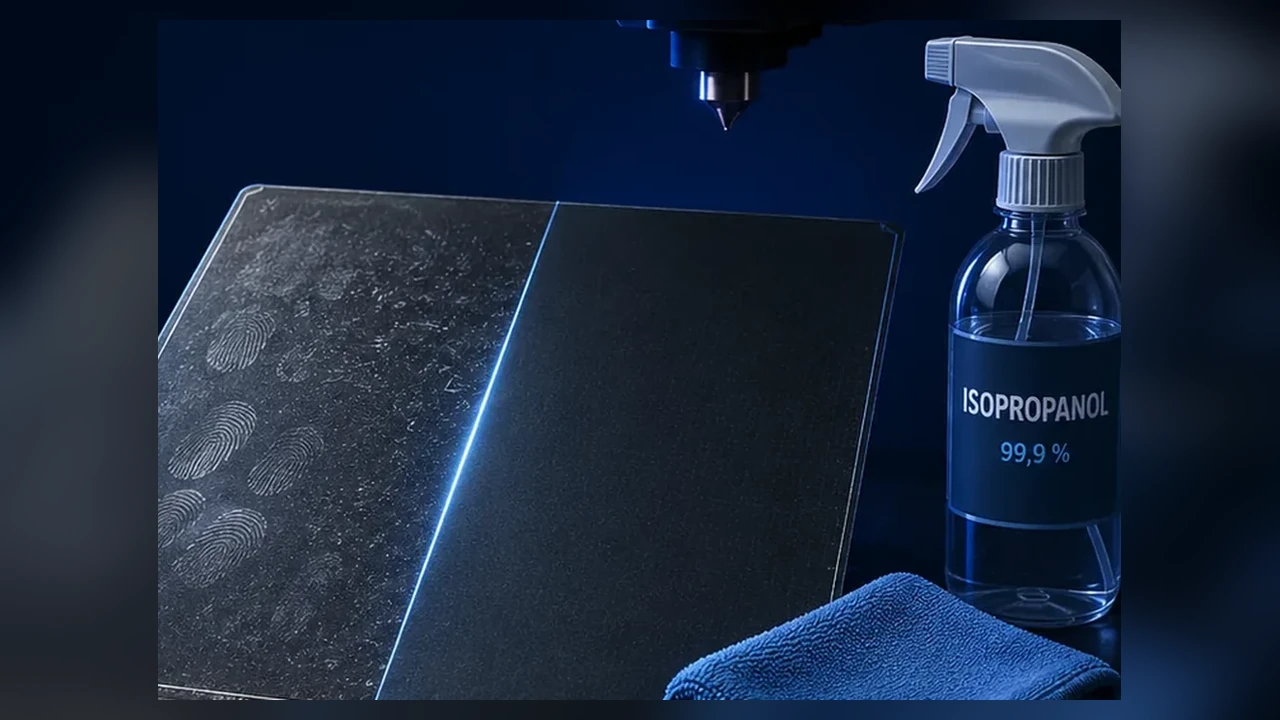
Skin oils create a thin hydrophobic film that can reduce adhesion in exactly the area you touched. The result may look like uneven leveling because one region fails while the rest of the plate works normally. Handle removable plates by their edges whenever possible.
Quick cleaning with isopropyl alcohol (IPA)
IPA is convenient for light grease and dust between prints when the plate manufacturer allows it. Use a clean low-lint cloth and enough liquid to lift contamination. A nearly dry dirty cloth can simply spread the oil over a larger area.
Deep cleaning with water and dish soap
Identify the exact plate first. “PEI” alone is not cleaning approval: film, powder coating and specialty surfaces may require different care. Use water and non-moisturizing dish detergent only when approved for that plate.
For example, Prusa recommends IPA on a cold textured steel sheet. Washing with warm, not hot, water and a little dish detergent is an infrequent last resort for persistent adhesion problems; the sheet is not waterproof. Do not soak it or leave it wet.
When washing is approved, remove residue, rinse thoroughly, dry completely and handle only the edges. Avoid hand soap with skin-care additives. If adhesion remains poor, stronger chemicals or abrasion are not the automatic next step.
Problematic cleaners
Hand soap and moisturizing cleaners
Many contain skin conditioners that leave exactly the type of residue you are trying to remove.
Glass cleaner
Some formulations leave surfactants or anti-streak additives. They may look clean but reduce adhesion.
Acetone
Acetone can be useful on certain surfaces and harmful on others. Never assume it is safe for a coated plate.
Sandpaper or abrasive pads
Abrasive treatment permanently changes the surface. Only use it if the manufacturer explicitly recommends it for that plate.
When glue is useful — and when it is not
Glue is not always an adhesion aid. On some plate/material combinations it acts as a release layer to prevent PETG, TPU or another polymer from bonding too aggressively to the surface. Follow the plate and filament guidance instead of treating glue as universally good or bad.
Smooth PEI, textured PEI and specialty plates
These are product-specific examples, not approval for every similarly named plate.
| Specific surface | Documented care | Limit |
|---|---|---|
| Prusa Smooth Steel Sheet | IPA on a cold sheet; acetone only in the explicitly documented exceptional case. | Do not transfer acetone approval to textured or other coated plates. |
| Prusa Textured Steel Sheet | IPA on a cold sheet; washing only as an infrequent last resort. | No acetone. The sheet is not waterproof. |
| Other PEI, satin or specialty plate | Check manufacturer, exact product and current care instructions. | Appearance or surface name alone does not establish chemical compatibility. |
Release layers and plate profiles also depend on the specific product and filament. Cleaning approval does not establish whether PETG or TPU may be printed directly on it. Care section checked October 13, 2026.
Is the problem really cleaning?
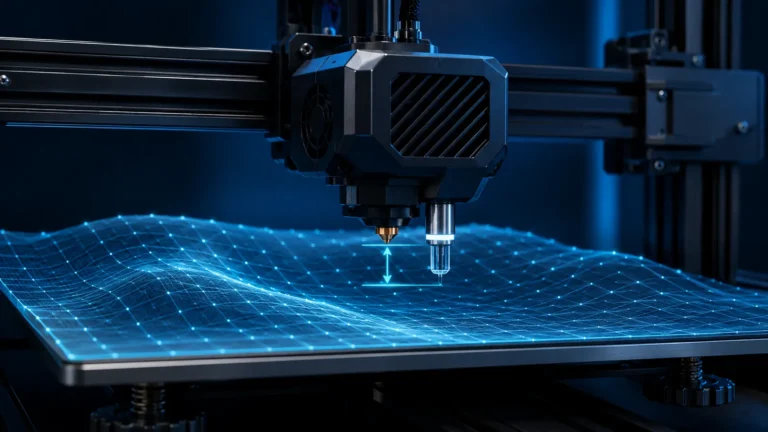
If the entire first layer is uniformly too high, cleaning will not fix Z reference. If a large ASA part lifts after several millimeters, chamber temperature and warping are more likely. Cleaning is the first diagnostic step, not a universal explanation.
A safe everyday routine
Let the plate cool, remove the part as instructed and check the underside and bed contact surface for loose debris. Use the approved cleaning method, dry completely and seat the plate correctly. Handle only the edges afterward.
For an interpretable comparison: use the same small first-layer file, material, plate profile and temperatures. Change only cleaning initially. Record whether the problem is uniform or limited to particular positions. Improvement supports a surface-related explanation but does not prove it: reseating the plate or automatic probing may also have changed the result.
If the surface is clean but the first layer remains inconsistent, follow the ABL and Z Offset guide. Stop the print if the nozzle scrapes or damage appears rather than adding more squish.
Typical beginner mistakes
- Touching the center of the plate after cleaning.
- Using a dirty microfiber cloth repeatedly.
- Compensating contamination with excessive first-layer squish.
- Assuming every PEI plate tolerates acetone.
- Applying more glue without first removing the old layer.
How often should a build plate be cleaned?
There is no useful universal number of prints. Light IPA cleaning can be done as needed; deep cleaning is justified when adhesion becomes inconsistent or after heavy handling. A plate used carefully may stay reliable for many prints.
Reassess after a material change
A surface that works perfectly for PLA can behave differently with PETG, TPU or ASA. The required bed temperature, release layer and cleaning method may change with the polymer.
Too little adhesion and too much adhesion are different problems
More adhesion is not always better. Strongly bonding materials can damage a coating when removed. If a manufacturer recommends glue as a barrier, do not remove it simply because the part “already sticks well.”
Remove finished parts without damaging the plate
Let the plate cool when appropriate, flex removable spring steel evenly and avoid digging sharp metal tools into coated surfaces. If the part refuses to release, follow the material/plate guidance rather than forcing one corner.
Build-plate lifetime: wear is normal
Coatings are consumables. Repeated abrasion, aggressive chemicals, excessive adhesion and nozzle contact can eventually change the surface. A plate that has become permanently glossy, damaged or locally inconsistent may need replacement rather than stronger cleaning.
Checklist when the first layer will not hold
- Plate clean and barely touched after cleaning?
- Correct plate type selected?
- Correct bed temperature?
- Nozzle tip clean before probing?
- Plate seated flat?
- First-layer lines joined correctly rather than floating?
- No strong draft for shrink-prone materials?
Quick cleaning and deep cleaning are not the same
IPA and washing are different tools, and both require approval for the exact plate. A detergent wash is not a routine reset for every coated steel sheet.
What about glue residue?
If glue is intended as a release layer or adhesion aid, refresh it according to the product instructions. Thick uneven layers can create their own surface inconsistency. Remove old buildup before applying a new controlled layer.
Conclusion
A clean build plate is one of the highest-value troubleshooting steps in FDM printing. It is cheap, repeatable and prevents users from “tuning around” contamination with bad Z-offset or temperature changes.