
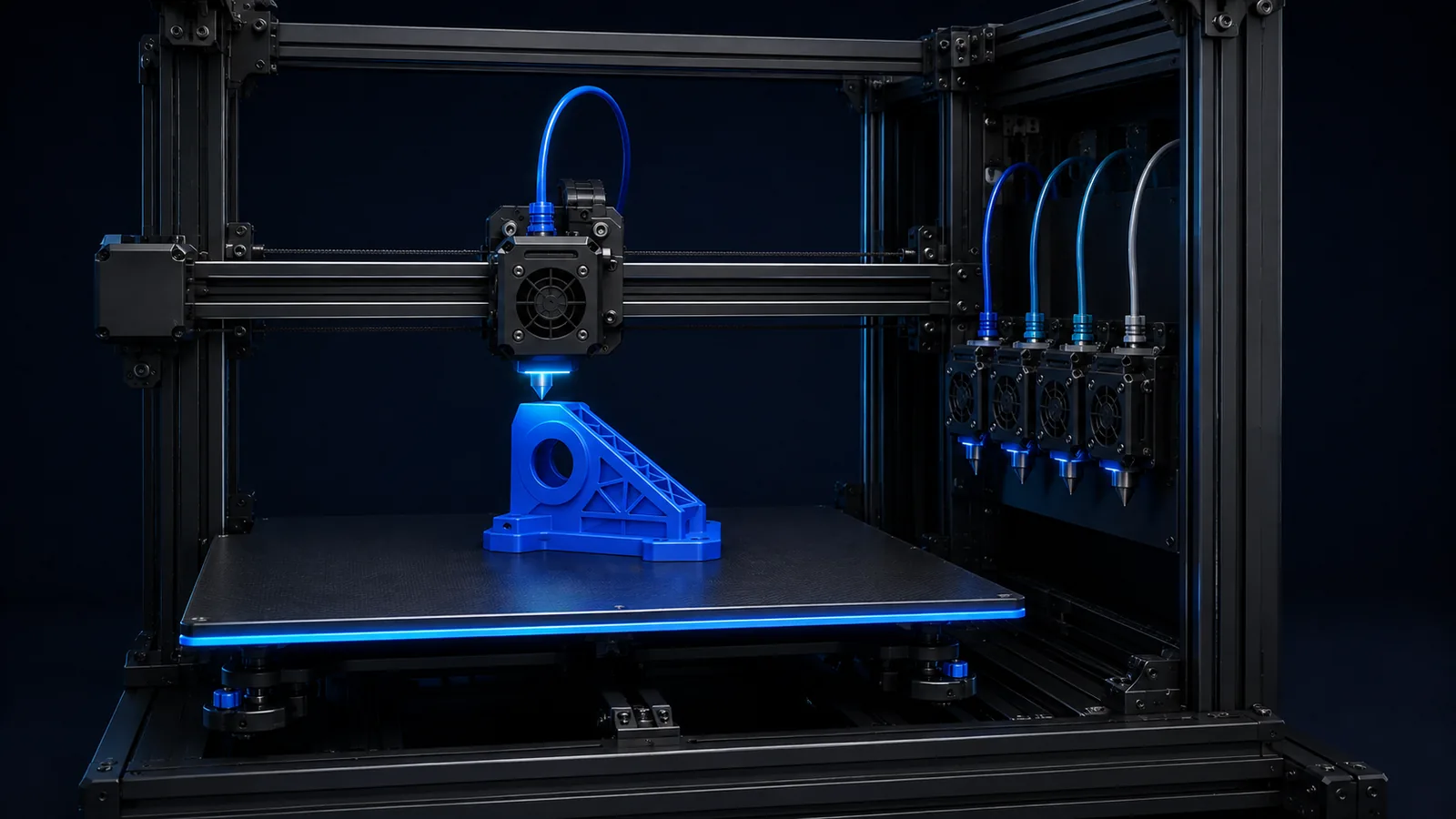
What is a Toolchanger?
A Toolchanger automatically swaps complete printheads during a job. The active tool is picked up, while unused tools remain parked in dedicated docks. Unlike AMS/MMU-style systems, the printer is not simply feeding another filament through one shared nozzle.
Why this matters
Each tool can have its own hotend, nozzle, temperature and material. A PLA-to-PETG change or a switch from a 0.4 to 0.6 mm nozzle does not need to pass through one melt zone. This can dramatically reduce purge and enables true multi-material and multi-nozzle workflows.
More than color changes
- main material plus dedicated support interface,
- different nozzle diameters in one job,
- rigid plus flexible material,
- multiple colors without a shared hotend path,
- specialized tools on systems designed for them.
Offsets and docking are critical
Multiple independent tools require accurate calibration. Tool offsets must be correct so material boundaries and surfaces align. Prusa provides dedicated multi-tool offset calibration for the XL. Dock positions also need to be reliable for collision-free pickup and parking.
Standby temperature and ooze
A parked tool often remains warm. Too high a standby temperature encourages ooze and material degradation; too low a temperature makes each change slower. Wipers or small prime structures may still be useful even with separate hotends.
Toolchanger vs. IDEX vs. AMS/MMU
IDEX usually uses two permanently mounted independent heads and is especially strong for Copy/Mirror. AMS/MMU changes filament into a common nozzle and is compact but normally requires more purge. A toolchanger fully separates tools and scales more easily to several heads, at the cost of greater mechanical and calibration complexity.
Practical rule
A toolchanger does not remove every source of waste. Optimization shifts from flush matrices toward docking, tool offsets, standby temperature and restart priming. For demanding multi-material printing, however, physical tool separation is a major advantage.