
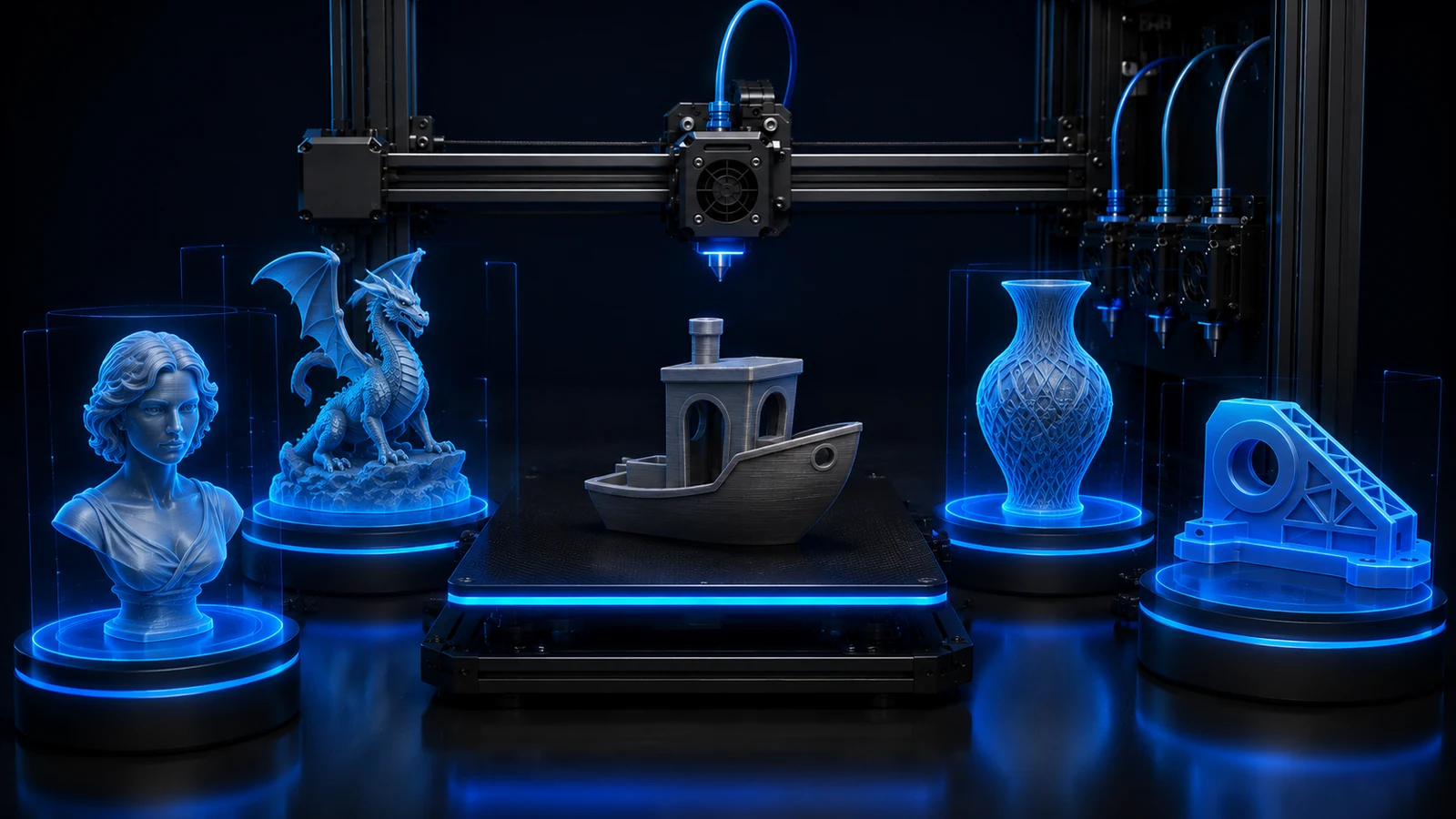
AI 3D generators are evolving so quickly in 2026 that a comparison without exact version dates is almost meaningless. Meshy shipped Meshy 7 and new print-oriented tools in August, Tripo lists H3.1 as its current flagship, Hi3D released v3.0 with 2048³ modes, and Rodin now exposes Gen-2 capabilities. Open systems such as Hunyuan3D 2.1 and TRELLIS.2 remain technically important as well.
Quick overview: which tool is interesting for which printing workflow?
| System | Current state | Especially interesting for | 3D-printing view |
|---|---|---|---|
| Meshy | Meshy 7 + Meshy 6 Lite | text/image/multi-view, Multi-Image Ultra, repair, Auto Split, multicolor, 3MF | very broad print-oriented ecosystem; Auto Split is now a dedicated print-oriented API |
| Tripo | H3.1 Stable + P2.0 Preview | high geometry density, multiview, native quad topology, controllable mesh budgets, parts | H3.1 is the stable detail generator; P2.0 Preview adds a topology workflow |
| Hi3D | v3.0 | image-to-3D, 2048³, split, multicolor, relief, STL/3MF | increasingly relevant for 3D printing because print-specific features are expanding rapidly |
| Rodin / Hyper3D | Rodin Gen-2.5 | geometry generation, editing, symmetry/image controls and documented texture tiers | asset and editing workflow; printing still requires mesh inspection |
| Hunyuan3D | 2.1 | open weights/code, image-to-shape, PBR pipeline, local workflows | excellent for users who want control and local integration |
| TRELLIS.2 | 4B open-source model | high-resolution image-to-3D, complex topology, local research/workflows | powerful technology, but not a finished “send to slicer” product |
| Sloyd | v3.18 – checked Sep 14, 2026 | text/image/multi-image, 2–4 views, up to 500K polys, tri/quad, Split to Parts, Multicolor Print | current print-oriented web-app state; commercial 3D printing remains a licensing exception |
What actually matters for 3D printing
Most AI tool comparisons focus on renders, textures and visual wow factor. Printing has different priorities. A model can look fantastic in a browser viewer and still require repair, thickening or scaling before it becomes useful in a slicer.
- Geometry: is the mesh closed, consistent and free of obvious self-intersections?
- Detail: is fine detail real geometry or only texture information?
- Wall thickness: will horns, fingers, wings, straps and thin plates survive at the intended scale?
- Hidden surfaces: are backsides and undersides plausible or heavily invented?
- Part separation: can a large or multicolor model be split intelligently?
- Scale: is there useful size/origin control or must everything be corrected externally?
- Export: are STL and 3MF native options, or is conversion from OBJ/GLB required?
- Post-processing: repair, remesh, retopo, split and multicolor tools often save more real time than slightly better render quality.
Meshy: from generator to print workflow
Meshy is especially notable in August 2026 because the platform now extends far beyond generation. The official API changelog added Meshy 7 for image-, multi-image- and text-to-3D on August 12/13. Ultra mode targets finer surface detail, while Smart Topology supports controllable polygon counts and native part separation.
For makers, the surrounding workflow matters: Meshy supports 3MF, Printability Analyze/Repair, Multi-Color 3MF and Auto Split. These are vendor features, not guarantees of a successful print.
At the September 14 research checkpoint, Multi-Image-to-3D supports ultra_mode with Meshy 7; Smart Topology documents T2. Auto Split is also a dedicated API for Meshy 6/7, with automatic splitting, by_parts or by_color. Optional processing includes mortise-and-tenon joints, thin-area reinforcement and build-plate arrangement. Outputs still need a slicer check.
Since September 11, meshy-6-lite replaces Meshy 5 as the faster, lower-cost variant. Meshy 7 remains the comparison’s quality reference. The free browser STL Editor handles scaling, rotation, measurement and units; it does not replace mesh repair. Use the linked API documentation for current availability and credit costs.
The 3D Agent remains a Beta. It aims to connect ideation, references, generation and export conversationally. That is promising, but for repeatable printing workflows we would still verify each geometry, repair and slicing step rather than treating the agent as an automatic guarantee.
Tripo H3.1 Stable + P2.0 Preview: detail and topology
At the September 14 research checkpoint, Tripo documents H3.1 / v3.1-20260211 as its stable generation model. P2.0 Preview, introduced on August 19, adds native quad topology and controlled mesh budgets in the Smart Topology workflow. It remains a preview alongside H3.1, rather than a stable replacement. Check the linked official model documentation before choosing a workflow.
Very dense geometry is useful but not automatically better for printing. Two million faces can preserve organic detail while making a small FDM model unnecessarily heavy. Smart low-poly or a controlled later remesh may be more practical depending on the print scale.
Multi-view is a meaningful advantage because extra reference angles reduce how much of the hidden geometry must be guessed from one image.
Hi3D v3.0: now a serious printing contender
Hi3D belongs in any serious current comparison. The official changelog on August 19, 2026 added Hi3D v3.0 with 2048quality and 2048master modes. The v3.0 page promotes 2048³ geometry generation and textures up to 8K.
More important for our focus, the August API updates added 3MF output, 3D Model Split with pin joints and merge, Multi-Color 3MF, and Relief export including STL/GLB/3MF. That is a clear move toward physical fabrication rather than only visual assets.
This still does not make every v3.0 output automatically printable, but the combination of high-resolution geometry, splitting and print-native formats makes Hi3D particularly interesting for figures, reliefs, collectibles and multicolor projects.
Rodin / Hyper3D: premium assets and editing rather than print automation
The September 14 comparison includes the Rodin Gen-2.5 API line. The August API changelog documents image_label and is_symmetric, texture-resolution tiers and add-on pricing. This is a generation and editing update, not evidence of automatic printability.
For printing, the attraction is geometry quality and editability. Native quads are much friendlier for DCC/sculpt/edit workflows than chaotic triangle meshes. Hyper3D’s own current review also notes that visually strong Rodin output can still require manual refinement for 3D printing, so we do not award an automatic “print-ready” label.
Hunyuan3D 2.1: open, capable and more technical
Tencent’s Hunyuan3D 2.1 is a different kind of contender. It is not merely a convenient web app: model weights and training code are available, with an image-to-shape model and a separate PBR paint pipeline.
The official repository lists roughly 10 GB VRAM for shape generation, 21 GB for texturing and up to 29 GB for the combined workflow. That is less approachable for beginners but valuable for local pipelines, research, ComfyUI/Blender integrations and users who want more control.
As with every system here, generative fidelity should not be confused with engineering accuracy. Hunyuan3D is an asset-generation system, not parametric CAD.
TRELLIS.2: impressive open-source technology, deliberately not a print tool
Microsoft’s TRELLIS.2 uses an O-Voxel representation and a 4B model. The official implementation supports image-to-3D at 512³, 1024³ and 1536³ and exports GLB after remeshing/decimation. It can represent complex topologies, open surfaces, non-manifold geometry and internal enclosed structures.
That last feature illustrates why “technically powerful” and “automatically printable” are not the same thing. A slicer generally needs a clearly interpretable solid. TRELLIS.2 is extremely interesting for advanced local AI-3D workflows but is not our first recommendation for someone who simply wants to upload an image and immediately slice the result.
The official repository also specifies an NVIDIA GPU with at least 24 GB VRAM for the tested local setup.
Sloyd v3.18: AI and parametric templates
Sloyd combines text/image/multi-image generation with parametric templates. The web-app version recorded at the September 14 research checkpoint is v3.18. Publicly dated intermediate release notes are not available in this comparison, so we do not attribute individual features to specific intermediate versions. Templates can offer a more predictable starting geometry than fully freeform generation.
The current platform also lists Split to Parts and Multicolor Print among its 3D tools. Official pages advertise STL and 3MF among print-oriented export formats. That makes Sloyd a practical alternative for props, variants and quickly customizable forms.
Text-to-3D and Image-to-3D need separate winners
A single global ranking would be misleading. Text-to-3D rewards prompt interpretation and creative shape generation. Image-to-3D is more about silhouette, proportion, backside reconstruction and fidelity. Multi-view is another category again.
| Goal | Interesting candidates | Why |
|---|---|---|
| rapid ideation from text | Meshy, Tripo, Sloyd, Rodin | finished cloud workflows and fast iteration |
| single image → detailed model | Hi3D, Tripo, Meshy, Rodin | current high-detail/high-resolution generation |
| multiple reference views | Tripo, Meshy, Sloyd | official multiview/multi-image pipelines |
| local/open-source workflow | Hunyuan3D 2.1, TRELLIS.2 | local hardware, reproducible pipelines and deeper integration |
| direct print-oriented helper tools | Meshy, Hi3D, Sloyd | repair/split/multicolor/3MF or dedicated print workflows are explicit product features |
FDM vs resin: the same file can perform very differently
Resin benefits more from fine organic detail, thin ornament and surface structure. FDM needs more robust small features, manageable overhangs and detail that matches the nozzle. A high-resolution AI mesh can therefore look excellent in resin while losing many details on a 0.4 mm FDM setup.
For FDM, intelligent part separation is often especially valuable because each section can be oriented for reduced support. For multicolor FDM, splitting can also reduce tool/color changes and purge. That is where Meshy’s Auto Split and Hi3D’s split/joint functions become strategically interesting.
Functional parts: none of these replaces CAD
For a bracket, adapter or replacement part, it is not enough for a bore to look circular. It must have the intended diameter, axes must line up and mating faces must be controlled. Current AI 3D generators are already excellent at creative shapes but do not provide reliable design intent.
For functional parts, AI is currently better viewed as a concept/form tool or starting mesh for later CAD reconstruction. Parametric CAD remains the controlled route for fits, threads, bearings, snap features and defined tolerances.
Commercial use: check the plan, not just the logo
Licensing differs between providers and changes over time. Meshy documents plan-dependent rights, Tripo also ties commercial use to plan level, and Hi3D differentiates between free and paid usage. Hunyuan3D 2.1 has a major regional caveat because its official Community License excludes the EU, UK and South Korea. Sloyd needs another distinction: paid web-app plans can include general commercial use, while the separate Terms of Use require a custom license for commercial 3D printing.
For any commercial project, check the current terms and the exact subscription tier on the day you generate the asset. You must also own the rights to uploaded reference material. An AI platform cannot grant you rights to someone else’s character, trademarked product or copyrighted design.
Our provisional recommendation for 3D printing
Meshy is currently the most rounded choice for users who want a cloud workflow with many explicit printing features. Hi3D has moved up quickly with v3.0 and its new split/multicolor/3MF capabilities and deserves close attention for high-quality image-to-3D work. Tripo H3.1 is a strong candidate when geometry detail and multiview matter most; P2.0 Preview additionally makes Tripo interesting for controllable native quad topology.
Rodin is attractive when continued editing matters. Hunyuan3D 2.1 and TRELLIS.2 are valuable for local/open technical workflows. Sloyd v3.18 remains a much more serious print candidate thanks to Multi-Image, high polygon targets, tri/quad output, Split to Parts and Multicolor Print — with the important licensing caveat for commercial 3D printing.
What we want to benchmark next
- the same reference object across multiple image-to-3D systems,
- the same prompts for an organic figure and a hard-surface object,
- exported mesh checks: manifold state, open edges, internal faces and polygon count,
- the same final size in OrcaSlicer and a resin slicer,
- repair effort required before a model truly slices cleanly,
- Auto Split / part-separation quality,
- selected real-world print tests.
Once these reproducible tests are available, we will add a dedicated benchmark table. Until then we deliberately separate officially documented capability from our own measured results.
Conclusion
The AI 3D market in 2026 is no longer only about pretty previews. Meshy and Hi3D are building explicit 3D-print and multicolor functions, Tripo pushes geometry detail and multiview, Rodin focuses on premium editable assets, and open-source projects such as Hunyuan3D and TRELLIS.2 keep raising the technical bar.
For makers, that is good news: the path from image or prompt to a physical model is getting shorter. The key skill remains critical validation. An AI model is only good when its actual geometry works in the slicer and on the printer.
Sources & version references
- Meshy API Changelog – Meshy 7, 3MF, Multi-Color, Printability
- Meshy Webapp Changelog – 3D Agent Beta, Auto Split, Smart Topology
- Meshy – free browser-based STL Editor
- Meshy API Changelog – Multi-Image Ultra Mode, Sep 1, 2026
- Tripo H3.1 / v3.1 – official model documentation
- Tripo P2.0 Preview – native quad topology and mesh budgets, Aug 19, 2026
- Hi3D API Changelog – v3.0, 2048³, 3MF, Split, Multicolor
- Hi3D v3.0 – official product page
- Hyper3D API Changelog – Rodin Gen-2.5, August 2026
- Tencent Hunyuan3D 2.1 – official GitHub repository
- Tencent Hunyuan3D 2.1 – Community License / regional exclusion
- Microsoft TRELLIS.2 – official GitHub repository
- Sloyd – current platform and features
- Sloyd – current web-app pricing and credit costs
- Sloyd – Terms of Use, commercial 3D-printing license rule
Research status: September 14, 2026. Models, betas, previews, pricing, credits and licensing can change at short notice.
Frequently asked questions
Which AI 3D generator is best for 3D printing in 2026?
There is no universal winner. Meshy currently offers the broadest print-oriented workflow, Hi3D v3.0 is expanding 3MF, splitting and multicolor rapidly, and Tripo H3.1 is strong for detail and multiview. Hunyuan3D and TRELLIS.2 are relevant for local open workflows.
Is Hi3D a real alternative to Meshy and Tripo?
Yes. Hi3D v3.0 is now a serious contender, especially for image-to-3D and print-oriented workflows. Its API now includes 3MF, model splitting and multicolor capabilities.
Are AI-generated models directly printable?
Sometimes, but not reliably by default. Always inspect mesh errors, wall thickness, undersides, scale, overhangs and the real slicer preview.
Are cloud generators better than open-source models?
They are easier as finished services. Hunyuan3D and TRELLIS.2 offer more local control and integration potential but require more technical setup and hardware.
Which generator is best for functional parts?
None of these replaces parametric CAD for fits, bores, threads or controlled tolerances. AI is better used for concepts, organic forms and starting geometry.

